

What is the H30-XB80 load rating?
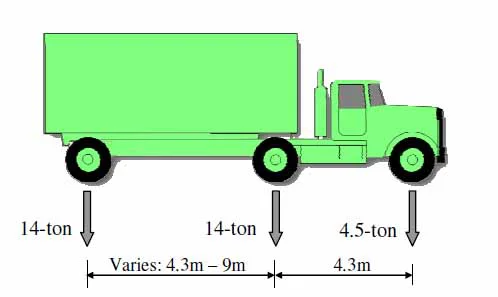
HL93 Load for Manhole Covers (H30-XB80) is not just a single vehicle but an unlimited train of vehicles (each vehicle having 3 axles with 6, 12, and 12 tons respectively). When calculating, you need to know the distance between the axles, the distance between the wheels on one axle, as well as the distance between one vehicle and another; Compare this with your structure to arrange vehicles appropriately.
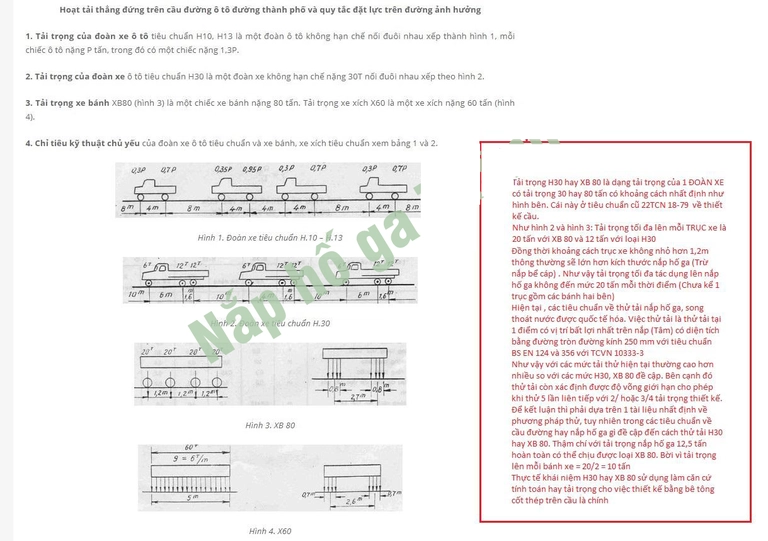
- The symbol **H30-XB80 Manhole Cover Load** refers to the **design load** and the **checking load** (when applying procedure 18-79).
- The **H30 load** is not just a single vehicle but an unlimited train of vehicles (each vehicle having 3 axles with 6, 12, and 12T respectively). When calculating, you need to know the distance between the axles, the distance between the wheels on one axle, as well as the distance between one vehicle and another; Compare this with your structure to arrange vehicles appropriately.
- According to QT 18-79, when you calculate with the **H30 load**, you must check it again with the **XB80 vehicle**. The XB80 vehicle has a weight of 80T, consisting of 4 axles, each axle is 1.2m apart and weighs 20T (it is a wheeled vehicle, not a tracked vehicle as previously mentioned). When calculating the H30 load, you must multiply it by the **impact factor (1+W)**, but when checking, you do not multiply it by that factor.
It can be affirmed that the load value of the design vehicle or the heaviest vehicle in the design convoy specified in the design standards **cannot be used to regulate or post signs** restricting the operating load for road bridge structures.
It can be affirmed that the load value of the design vehicle or the heaviest vehicle in the design convoy specified in the design standards **cannot be used to regulate or post signs** restricting the operating load for road bridge structures.
There are still many people who believe that if a bridge is designed with a design vehicle load of a certain tonnage, then the maximum operating load allowed will be the same tonnage. Specifically, in our country, if bridges are designed with the H30, H13, or H10 design loads according to standard 22TCN 18-79, the maximum load of the vehicle allowed to cross the bridge is simply conceptualized by them as a 30-ton, 13-ton, or 10-ton vehicle or convoy. Such a notion is incorrect. Please allow me to quote the Australian bridge design standard (Austroads: Bridge Design Code 1992) to clarify the nature of bridge design load. Section 2.3. Live Loads of this standard states the following: “Live loads are the loads of the traffic stream (individual vehicles or convoys) or of pedestrians. The nominal, theoretical load values and arrangements specified in the standard will create effects in the structure equivalent to the effects created by individual vehicles or convoys in reality.”
In other words, the determination of the vehicle load or design convoy load for the bridge is carried out according to the principle of **H30-XB80 Manhole Cover Load** as follows: Starting from the reality that individual vehicles or convoys manufactured to operate on the road system have very different loads. The random operation of these vehicles will cause very different effects in the components of the bridge structure such as internal forces, deformation, displacement, vibration, reduction of structural durability according to the traffic flow and intensity, and according to the operating time...
See more: HL93 Standard and common misconceptions!
The layout diagrams and load values found are the loads of the design vehicle or convoy, or more accurately, the design live load. They can be series of concentrated or uniformly distributed forces as specified by standards such as the Russian CHnII 84, the American AASHTO 1994 or 1998, or the current Vietnamese 22TCN 272-05... They can also be hypothetical individual vehicles and design convoys (which are also, in essence, series of concentrated forces) as specified by the Vietnamese standard 22TCN 18-79, the former Soviet Union's CHnII 200-62, the American AASHTO 1992, the Federal Republic of Germany's DIN 1072, the Australian AUSTROADS 1992....
To further clarify this, let me reiterate the nature of the **H30-XB80 Manhole Cover Load**, H10, H13, and X60 loads for road bridges specified in the Bridge Design Standard 22TCN 18 - 79. Article 2.12 of this standard specifies: “The standard vertical live load (considering future development) is taken as follows: Use H30 and XB80 loads for international link roads, major trunk roads of important economic, political, cultural, and national defense significance serving the whole country, with very large future traffic intensity, as well as transport roads connecting important industrial zones with major cities and national trunk roads of class IV or higher...
To calculate the internal forces due to the vertical live load in
Throughout more than a quarter of a century, bridges constructed in the northern provinces of our country were primarily designed based on the **H30-XB80 Manhole Cover Load** diagrams; H13 - X60 or H10 - X60 according to the aforementioned 22TCN 18 - 79 standard. And for a quite long period, many newly designed and constructed bridges according to these load diagrams were posted with signs restricting the load to 30 tons, 13 tons, or 10 tons (?).
As for bridges designed according to the H13 or H10 design loads under 22TCN 18 - 79, it also cannot be assumed that the maximum vehicle load allowed to cross the bridge is 13 tons or 10 tons for the purpose of posting load restriction signs.
In summary, the design vehicle and convoy load diagrams specified in the bridge design standards are all theoretical and hypothetical in nature so that the design calculations are simplified, but the bridges designed and constructed must meet the requirements for normal circulation of all road transport vehicles manufactured for road transport duty.
Similarly, it is also not possible to conduct load testing with a convoy of vehicles in the very one-sided way load testing is currently understood, and then draw unfounded conclusions about posting signs restricting the load capacity of bridges suspected of being degraded, or as many people still subjectively call, without sufficient basis, "weak bridges"./.
-
The **H30-XB80 Manhole Cover Load** effect is caused by a design load diagram specified as the standard H30 convoy consisting of 2 types of 3-axle vehicles with a total load of 30 tons each, arranged alternately with a distance of 10m from the second rear axle to the front axle of the next vehicle with unlimited length. Both types of vehicles have a front axle of 6 tons, the next rear axle is 12 tons, but one type has the rear axle 4m from the front axle, and the other type is 6m from the front axle, followed by the second rear axle of 12 tons which is 1.6m from the previous rear axle.
- Statistical processing of these effects will find the envelope, which is the set of maximum values of those effects. The problem for bridge design standard researchers and editors is to find a load arrangement with selected load values such that their effect caused in the bridge structure is equivalent (and in reality much larger because it includes the load factor to ensure safety and considers the future development of the load in both value and quantity to ensure the service life, i.e., the design standard life of the bridge structure) compared to the effects obtained through the statistical processing calculation mentioned above.
-
Use H10 and X60 or H13 and X60 loads for local roads within the province, industrial traffic roads, and provincial economic roads belonging to the road system class IV or below.” In addition, this regulation also notes that when calculating for fatigue resistance, wheeled or tracked vehicle loads are not used. When considering wheeled or tracked vehicle loads, automobile and pedestrian loads are not considered.
-
These live loads are all allowed to be converted into equivalent uniformly distributed loads. The above regulation was drafted based on the regulation of the former Soviet Union's CHnII 200-62 bridge design standard and has content entirely similar to the regulation of CHnII 200-62.
-
Similarly, bridges in the South designed and constructed according to the AASHO or AASHTO standards with the design loads H20 - 44 or HS25 - 44 were also posted with signs restricting the load to 20 tons, 25 Tons (?). Even in the 90s of the last century, in some bridge projects in our country built with ODA funds, foreign consultants designing according to AASHTO standard made a big mistake by increasing the HS20 - 44 design load by 25% to be “equivalent” to Vietnam's H30 design load (?).
-
These notions and practices have caused considerable difficulties for road transport operations and unnecessarily increased the scale and cost of bridges. Only after the HL93 design load, which has a uniformly distributed load diagram according to the 22TCN 272 - 01 bridge design standard (which was supplemented and amended to 22TCN 272 - 05) was applied, did the posting of 30-ton load restriction signs for newly constructed bridges designed according to the H30 or HL93 design load cease. Yet, there are still some recent bridges where, after construction, functional authorities still propose to post signs restricting the vehicle load to 30 Tons with the argument that if the bridge was designed with H30, it should only allow vehicles with a maximum weight of 30 Tons to cross (?).
-
The practice of taking the exact load values of 30 tons, 25 tons, 20 tons, 13 tons, or 10 tons specified in the bridge design standards to regulate the operating load and post restriction signs for newly constructed and opened bridges is incorrect and needs to be stopped.
-
If based on the provisions of Article 2.12 of the aforementioned 22TCN 18 - 79 or similar provisions of the former Soviet Union's CHnII 200 - 62, provincial roads and roads of class IV and below can use H13 or H10 for design and construction.
-
This is also analogous to the fact that Americans are allowed to use the H15 - 44 or HS20 - 44 or HS25 - 44 design loads of the AASHTO bridge design standard to design and construct bridges on the American road network.
-
It is clear that in the general road network of the former Soviet Union and of Russia, and of the US and other developed countries today, it is not possible that vehicles that are allowed to circulate on national roads are not allowed to circulate on provincial roads, except in cases where the vehicles' length is incompatible with the road's limited curve radius, making circulation impossible.