

I only need translation, nothing else in this conversation.
What is the Density of Cast Iron – The Specific Weight of Cast Iron
Related Tag: #Iron
See more:
>> How are White Iron and Gray Iron Different?
>> What is Ductile Iron Made From – The Manufacturing Composition of Ductile Iron
What is the **Specific Weight of Cast Iron in kg/m³**? And is there a difference between ductile iron and gray iron? The answer is yes. So what is the density of gray iron and ductile iron?
Cast iron is an alloy of Iron and Carbon along with other components such as Silicon, Manganese, Nickel, Magnesium, Copper…
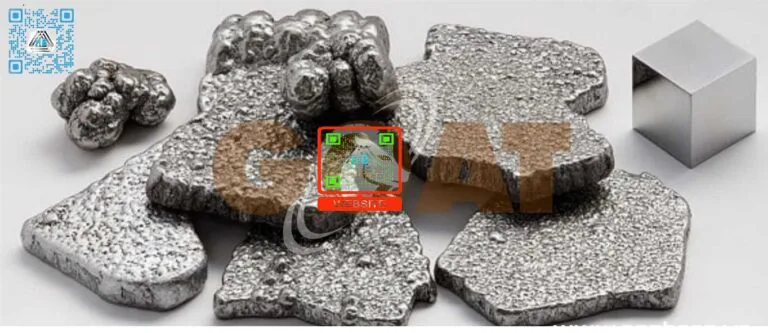
What is cast iron density?
We probably all vaguely remember the formula for calculating density (D=m/V). The formula extends throughout our high school curriculum.
So let's restate the definition with the specific material being cast iron:
“**Cast iron density** (also called cast iron mass density) is a characteristic of the mass density per unit volume of cast iron. It is a quantity measured by the quotient of the mass (m) of an object made of cast iron and the volume (V) of that object.”
What is the “unit of measurement” for the specific weight of Cast Iron?
The **Specific Weight of Cast Iron** mentioned in this article has units of **kg/m³** or **g/cm³**
What is the cast iron density in kg/m³?
As you know, different types of cast iron are categorized based on the proportion and composition of substances within the iron. Such as: Ductile iron, Gray iron, Malleable iron… Therefore, their density is not a constant. It has variations.
Density of cast iron
Cast iron density is in the range: **6,800-7,800 kg/m³**
**Specific Weight of Cast Iron** in various sources (internet in English):
#1. According to the summary table of **density data** (Density Data) reference:
**The specific weight of Cast Iron** ranges from 6,904 to 7,386 kg/m³. The average is 7,209 kg/m³
#2. According to byjus.com, the *cast iron density is 7.2 g/cm³*
| Type of Cast Iron | Density (g/cm³) |
| Ductile iron (Ductile iron) |
7.15 |
| Gray cast iron (Gray cast iron) |
7.15 (From 6.95 to 7.35) |
| Malleable iron (Malleable iron) |
7.27 (From 7.20 to 7.34) |
Among which, the **density of ductile iron** is usually chosen as **7.1 g/cm³**. And the **density of gray iron** is usually chosen as **7.15 g/cm³**.
How is the specific weight of cast iron different from density?
Specific weight is the weight of one cubic meter of material. Specific weight is different from density.
The unit of measurement for specific weight is N/m³
While the unit of measurement for density is kg/m³
Formula for calculating the specific weight of cast iron
**Specific Weight = Density x acceleration due to gravity = Density x 9.81**
(Or d = D x 9.81)
Formula for calculating the mass of cast iron
**Mass (m) = Specific Weight (d) x Volume (V) = Density (D) x 9.81 x Volume (V)**
(Or m = d x V = D x 9.81 x V)
Thus, to *calculate the mass of a cast iron object*, we need to calculate the volume of that object using the size parameters from the drawing. Then, one can choose the density value of cast iron within the range above.
Then by calculating according to the formula, you will be able to estimate the **mass of cast iron** of the object that will be cast into the finished product.
Example: Cast iron mass = 7200 x 9.81 x V (kg)
Below are the common types of cast iron:
- **Gray cast iron (Gray cast iron)**: Gray cast iron is one of the most widely used types of cast iron, especially in the automotive and railway industries. Gray cast iron is characterized by being tough, strong, and having good wear resistance. It is produced by heating iron ore and casting it into molds.
- **Nodular iron (Ductile iron)**: Nodular iron is created by adding magnesium or cerium to the gray iron production process, forming a network of nodular iron particles. This improves the elastic properties and reduces the brittleness of the iron. It is widely used in industrial applications, including water pipes, gas pipelines, car frames, and agricultural machinery parts.
- **White cast iron (White cast iron)**: White cast iron is created by heating iron ore and keeping it cold quickly, forming a hard and brittle structure. It is used in applications requiring high strength and wear resistance, such as cutting tools and machinery parts requiring robust properties.
- **Galvanized cast iron (Galvanized cast iron)**: This is a type of cast iron coated with a layer of zinc to increase corrosion resistance and extend the lifespan of the material. It is widely used in construction applications, such as water pipes and galvanized steel sheets.
- **Malleable iron (Malleable iron)**: Malleable iron is created by heating white iron in gas or methane for a long period to make it soft and ductile. It is used in applications requiring strength and ductile properties, such as pipe fittings and agricultural machinery parts.
- **Chilled cast iron (Chilled cast iron)**: Chilled cast iron is created by casting white iron into a lead mold, creating a hard shell and soft iron inside. It is used in applications requiring wear resistance and high strength such as gears and grinding machine parts.
- **Ferritic ductile iron (Ferritic ductile iron)**: Ferritic ductile iron is created by adding silicon to the nodular iron production process, forming a ferrite structure. This improves wear resistance and reduces the ductility of the iron. It is used in applications requiring wear resistance and high corrosion resistance.
- **Cast iron (Cast iron)**: Cast iron is a type of iron with a lamellar crystalline structure. It is used in applications requiring high strength and heat resistance such as stove tops, ovens, and cookware.